Showing posts with label Family. Show all posts

Thursday, October 15, 2015

First Relative Found Through DNA

Just over 2 years ago I ordered the Full Genome Kit from Family Tree DNA. This included a Y-DNA 67 Test, a Full Mt-DNA test, and an Autosmal DNA test (known as Family Finder). My main goal with these DNA tests was to learn about my paternal ancestry, something that I knew little about, as well as locating relatives. When I finally received my results I was stunned at the amount of matches I had in Family Finder and every surname in my Y-DNA matches had completely different surnames, both being quite common results for those with Jewish ancestry.

I found a handful of relatives who I had already found through the paper-trail but it was nice to have DNA confirm what old documents told us. I couldn't find anyone linking into my tree otherwise and throughout the years have contacted different matches in hopes of finding the link. The big hope was to find someone who not only linked into my tree but had more information than I did on the family. I expected the first person I would find to be a 3rd-5th cousin because I've known a lot of about my 1st and 2nd cousins (assuming no one has hidden an illegitimate child).

Finally after 2 years I found a match who had a not so common Jewish surname which was also in my tree. As well they had listed that family being from the UK and Holland, which basically confirmed it for me there because I have yet to find any families in Holland with the same surname. After contacting the relative and explaining what I knew she responded and told me that her sister had focused on researching that side of their family but she knew there was little information of where their side came from. After looking up the names she sent me for their most distant ancestors on that line I was able to find her great-grandfather in my tree. 

After adding her in and doing some quick calculations I realized that she was my 8th cousin exactly. I would have never imagined that the first relative I found through DNA would be so distant in relation. Our most recent shared ancestors were born in 17th century Amsterdam. Although I should also mention her sister had taken a DNA test but we did not match. Either way, it's great to finally have found a relative through the use of DNA and hope that I find more success in the near future.

Buy a DNA test
Family Tree DNA - https://affiliate.familytreedna.com/idevaffiliate.php?id=1614
23andMe - https://amzn.to/2K57c9j
Ancestry DNA - https://amzn.to/2K3ewSM
MyHeritage DNA - https://amzn.to/2M0bhgu

Friday, June 20, 2014

The Race Debate: Is there a Jewish race?

When I was in college I took a class called Jews in The United States. Obviously the class was focused around how Jews lived in the USA, but early on our professor Barbara Burstin brought up a question I had barely thought about; Who is a Jew? The class discussed multiple ideas of defining who is a Jew; someone born to a Jewish mother, one who practices the Jewish religion, one who descends from the 'Jewish People' (a.k.a. a Jewish race). What really stuck out with me is the idea of Jews as a race. At that point of the class I was a year into my serious genealogy research and had just begun to trace out my Ashkenazi roots in Holland, something I thought I'd never find from my Dutch Sephardic line. As well I had just learned about the Joods Monument, which I wrote about here. I was slowly realizing how connected the Jewish population around the world truly were, so the idea of the Jewish race just made sense to me.

When the class discussed this idea further I realized that many other Jews and non-Jews were quite against this idea. Some discussed how this was just anti-semitic and could lead to another Holocaust because the idea of Jews as a race is used by anti-semites in their propaganda. What the anti-semites do is use the argument of a Jewish race to say Jews have been bred to be evil and manipulative. I could understand why this would lead to many rational people saying the idea of Jews as a race is not only wrong but is morally wrong, especially when you read articles like this, but I think if you look at it with fears aside (there will always be crazy people in the World) you can see the proof in genetics. Another argument that was difficult to counter is the idea that Judaism is a religion and people leave or convert Judaism all throughout history, thus Jews couldn't be a race. While this argument is valid in a way, if you look at it in a different way it makes more sense why this is wrong (at least in my humble opinion).

The first thing you need to do is think of Judaism in two lights; the religion and the race. Yes, as two different things. To make this easier I will refer to the religion as Judaism and the race as Israelites. Judaism is just a religion anyone can enter or leave based on their personal beliefs. Israelites are those who descend from the people who lived in the Middle East who practiced the Jewish faith. So to be an Israelite would be your genetics consisting of mostly Israelite markers. What kept the Israelite DNA flowing throughout it's own community was the Jewish faith, a societal barrier which kept marriages within the Jewish community. Even after hundreds of years apart many people from around the world who claim themselves to be Jewish share a common descent which has been shown through DNA.

Anyone with a percentage of Jewish Diaspora genetic markers (what I previously referred to as Israelite markers) on Family Tree DNA could tell you how fascinating it is to see the thousands of Jews who are anywhere from 2nd cousins to 5th or 6th cousins. Most of whom rely on the chromosome browser to determine how they are related to the others. On Family Tree DNA in the My Origins section of Family Finder they talk about the Jewish Diaspora and say "While Judaism is a religion, the Jewish people are also a nation. Modern Jews have diversified into numerous branches, such as Ashekenazi, Sephardic, and Mizrahi, as well as odds and ends such as the Bene and Beta Israel. Unifying many of these populations are genetic commonalities, likely resulting from a common Middle Eastern Ancestry. This combination of Middle Eastern and European is found in many other groups, and many of them exhibit signatures of the Ashkenazi Diaspora, but it is not common descent."

Interestingly enough I see a correlation of this idea with a Muslim race but the World already refers to them as the Arab race. At this point some of you might say, "But there are a lot of Arabs who are Jewish, Christian, or other religions and a lot of Muslims who aren't Arabs." True but you can say the exact same thing about Israelites as there are hundreds of thousands who have converted to Christianity, Islam, and other religions over the past 5000 years as well as lots of Jews who aren't Israelite. I would even bet that many Christians with newly discovered Jewish ancestry are reading this, especially since it is more common for those with Sephardic ancestry.  I found out from my own DNA test that I am 6% Arab, meaning that one of my 2nd great-grandparents could be fully Arab (there are only three of my 2nd-great grandparents I don't know about, so possible) but at the very least I have a multiple 3rd great-grandparents and other ancestors further down with partial Arab blood.

In the end I think the main point I'm getting at is when it comes to "Is there a Jewish race?" the answer is Yes. If you look at it from a completely scientific standpoint based on genetic evidence you can see there is an abundance of proof that points in the affirmative.

Buy a DNA test
Family Tree DNA - https://affiliate.familytreedna.com/idevaffiliate.php?id=1614
23andMe - https://amzn.to/2K57c9j
Ancestry DNA - https://amzn.to/2K3ewSM
MyHeritage DNA - https://amzn.to/2M0bhgu

Saturday, February 8, 2014

The Consideration: Obtaining My Spanish Citizenship as a Sephardi

I have been thinking about becoming a Spanish Citizen. Due to my ancestry I will be able to do so quite easily without losing my current citizenship in the United States. I'm just not yet sure if I want to go through with it, so I have been researching it quite extensively.


There has been a buzz for a few years now about people of Sephardic descent being able to obtain citizenship in Spain without having to denounce their current citizenship. Just the other day on the 7th day of February in the year 2014, the Spanish Cabinet passed a new law giving a 2 year window for descendants of Sephardic Jews to apply for fast-tracked citizenship. While this law is finally coming to fruition it has been in the works for many years now. 

In 1992, King Juan Carlos prayed at Beth Yaacov Synagogue in Madrid to commemorate the 500th anniversary of the Alhambra Decree. King Carlos then declared "Sefarad is not nostalgia but a home which should not be said that Jews feel at home, because the Spanish-Jews are at home. What matters is not accounting for our mistakes or successes, but the will to project and analyze the past in terms of our future." In 2012 at a ceremony at Madrid’s Casa Sefarad-Israel the Justice Minister Alberto Ruiz Gallardón announced the Spanish Government would be opening automatic citizenship for anyone who could prove they descended from Sephardic Jews. 

There was a major problem with the 2012 law which made it impossible to work. It required a Certificate from the Federation of Jewish Communities of Spain (
Federación de Comunidades Judías de España) but the Federation refused to give out certificates until the Spanish government defined what documentation an applicant required to be considered Sephardi. Just over a year later the Federation of Jewish Communities of Spain are now praising the law passed by the Spanish Cabinet. A statement they released about the law said “The minister of Justice, Alberto Ruiz Gallardon, kept his word, and this honors him. Spain, once again, not only did not disappoint, but made a historical step for the Sephardic Jews”

The new law still must pass the Spanish Parliament before being officially implemented. While the law speeds up the process it still has stipulations which must be met. The law entails that the applicant prove they are Sephardi by one or more of the following requirements;

1. A certificate from the General Secretariat of the Federation of Jewish Communities of Spain saying the applicant is of Sephardic origin.

2. A certificate from the Rabbinical Authority legally recognized in the country in which the applicant resides.

3. Family names, languages, or other evidence of applicants connection to the Sephardic Community.

4. If said person was included in a list of Sephardic families protected by Spain such as the decree of December 29th, 1948 or those who obtained special naturalization through the royal decree of December 20th, 1924. 

5. The applicant can prove linkage to person or family member who the previous stipulation applies to.

6. In the event the application is sent to the civil registry office in charge of the residence of the applicant it will consider any applicant's sign of belonging to the Spanish community in their area.


If one or more of these stipulations are met then the applicant must also provide a statement of loyalty to the King of Spain and obedience to it's constitution and laws. The acquisition is then recorded in the Spanish Civil Registry. 

Now the question comes about of whether or not to go through with this...

If you would like to read the actual law please click link (warning: automatically downloads .pdf and is in Spanish);

Sunday, June 23, 2013

Basics of Exploring your Family Tree on Geni

Over my few years of doing genealogy I have found only one website which I feel the need to pay a membership; www.geni.com. There are a few reasons why I enjoy this website so much; The format of the website makes it much easier to find matches, exploring the tree is very simple, and it is easy to get down. When I first began my research I tried to build a small tree on Ancestry.com but found in my trial of the website that it was quite confusing just to get in contact with a relative. I also hated the format of the tree because it kept it in a two-dimensional format. While there may have been changes over the years since I last used ancestry I quickly found that geni.com gave me the tools I needed.

As many genealogist come to find out quite quickly, family trees are not 2, 3, or even 4-dimensial. They are infinitely dimensional; each person has a tree unique to only them with only a small percentage of their tree similar to those of blood origin (similar to the amount of shared DNA between relatives). The program geni.com has created for their tree format allows you to easily move from one dimension of the tree to another dimension of the tree. The basics of the tree are pretty easy to understand and the tutorials on this are plenty (a good video for beginners http://www.youtube.com/watch?v=I4VkZHcNu1o), but there aren't a lot of tutorials or explanations about how to explore and edit the tree beyond the basics.

So assuming you have a basic working knowledge of geni (if not, watch the video above and spend some time on the site to get a basic understanding), I will go into some simple features many people overlook.

Nodes
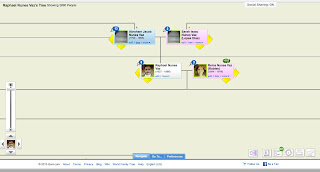
When you first open the tree window you will automatically be the focal person in the tree. For our example we will use Raphael Nunes Vaz. Within the tree each person is represented by what is called a 'node', with multiple links available at the bottom of  each node. Clicking the "tree" link on a person's node will make them the focal point of the tree. Each node will have yellow arrows pointing either up, down, left, or right. Clicking an up arrow will add a parent, clicking the down arrow will add a son or daughter, clicking the left or right arrow will add a sibling or a spouse. Some nodes (such as Reina Nunes Vaz') will also have a small tree above it with a number; the number indicates how many people are in that person's tree who aren't visible in the current tree. Clicking on the small tree above the node will make that person the focal point of the tree.
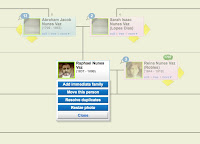
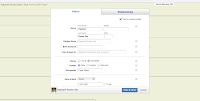

The edit link will cause a pop-up window to appear (pictured on the left) with Basics editing options and Relationship editing for that person. Basics is the automatic window but if you click on the relationship tab you can easily change parents if there is a mistake as well as editing dates and information for any spouses. There is also the option to change the spouse status to husband/wife, fiancè, ex-husband/wife (divorced), and ex-partner. The third link is the 'more' link which will show the following options when clicked (as shown above on right); add immediate family, move this person, resolve duplicates, send message, and resize picture.
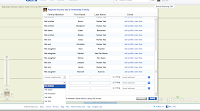

The "add immediate family" link brings up a page (shown on the right) which allows you to enter in multiple immediate family members at once(parents, siblings, spouses, and children) and also allows you to edit the already added immediate family members. The "move this person" link allows you to merge duplicate profiles and clicking the link will cause a mini-window to open with the a duplicate node (shown below), this window with an extra node will stay open even as you select other nodes to become the
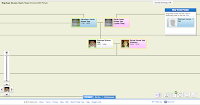
focal point of the tree. Once you have found the duplicate profile within the tree just drag the node from the other window over the duplicate profile. A window will pop-up asking what the relation of the one profile is to the other. The "resolve duplicates" link will open a window which allows you to quickly merge any duplicated immediate family members. Simply drag a duplicate profile over another duplicate and it will link them together. Clicking the "send message" link will allow you to either send a message to the person (if they accessed their profile) or the page manager.


Tree Preferences
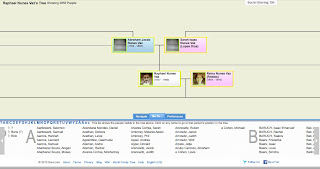

When looking at your tree at the bottom of the page you will notice 3 blue tabs; Navigate, Go To..., and Preferences. The "Navigate" tab gives you an eagles eye view of the whole tree as best possible (shown on the right), allowing you click on the section of the tree you'd like to go to. The "Go To..." tab gives you a list of all the names of the profiles being shown in this setup of the tree.  The "Preferences" tab gives you many different options on how you would like to view your tree.

Display

With the "Preferences" tab there are 4 sections; Display, Names, Revision, and Advanced. Under "Display" you can choose how many generations of ancestors you would like to show and how many generations of descendants you would like to show (it goes from 0-20 and then goes to All). There is also a checkbox for "direct ancestors only". Checking this box will make the view of the tree only show ancestors of the selected person, taking out any ancestor siblings or unrelated spouses from view.
It will still show any descendants of the selected person

In the middle of the display tab are 4 different options of the Tree Diplay; Standard, Vertical, Photos Only, and Names Only. The last options with the Display tab is layout options, each being a check-box; Show Photos, Flip Nodes (this means when you scroll over a node in the tree an information window about that person will pop-up), Click to Flip Nodes (Flip Nodes must be already selected), Show Yellow Arrows (the arrows all you to add family members), Show Email Prompt (will give a space in the node to enter the email of the person if they are listed as alive), Center Single Parents, Mark Deceased, Neutral Color Backgrounds, and Open Profile in New Windows (when selected this opens a new window when you click on a node to look at the person's profile).

Names and Revision

The names link is a series of check-boxes which affects the information given on each node. The options under this link are in two columns; one which you can only select one option, the other with multiple options. The first column affects the display of birth names in the tree; Do not display birth surnames, birth surname instead of last name, birth surname instead of last name in Caps, birth surname appended, in parenthesis (tree only). The second column affects how the name is displayed in each node; Ignore display name, Show Suffixes, Show middle names, Do not guess last names, and reverse RTL names (used for names in Hebrew/Arabic).

The Revision link allows you to change the display of revision history of the tree. You can see the revision history of each profile under the revisions tab within the person's profile page.

Advanced

These options allow you to change the physical view of the tree; Font size, Date format, and Rendering quality. All of these options are more for personal preference, so you can play around with it and see what you like best.

Tips

One of the best ways to really get used to the format is to play around with the tree and try to build it up to the point that you are able to merge with other trees on geni. Just viewing each tree from the focal point of all your different relatives can give you a great idea of how the program works. The help section on geni.com (http://help.geni.com/home) is very helpful and includes a whole community of experienced genealogists.

*A quick side-note that as you get into the more advanced options you may be limited if you have the Basic account. Differences between the types of accounts can be seen here.

Thursday, December 8, 2011

Friending My Sephardic Family; Using Facebook for Sephardic Genealogy

When I really started digging into my family genealogy I spent hours and hours online. In fact almost all of my research has been spent on the computer because of the massive amount of information on the internet. My first 'research' was finding trees built by distant relatives by googling family names and then putting them all into my own massive tree. I quickly found the website geni.com and used that as my main tree.

Most of these trees I found had been built from thousands of hours of research by older generations, usually on websites which dated to the late 90's and early 00's. I discovered that these trees had the names of many living relatives, some as close as 3rd cousins who I had never known about before. I started trying to find them by googling their names, searching the white pages online, and then by using Facebook.

I quickly found Facebook was an easy system to manipulate for my genealogy research. For all intents and purposes it has become something of a World Directory. It took patience but led to amazing discoveries, many which you can read in my previous post "Meeting Cousins". Here is how to manipulate Facebook to find living relatives and expand your tree.

The first step is to have a tree which has been traced back and then forward again. In other words, you need to have the names of living relatives who you are not in contact with. It is usually better to start with the people who will be easier to find. Here is some criteria to determine who will be easier to find;

1. Uncommon names - Either an uncommon surname or first name, especially a combination of both, helps narrow the search a lot.

2. Personal Info - The more information about the person and their immediate family you know the easier they will be to find. This can include age, location, education, and anything else people may list on their pages.

3. Bigger Families - By this I mean bigger immediate families, extending to their 1st and sometimes 2nd cousins. 

4. Millennial Generation a.k.a. Generation Y - Defined by William Strauss and Neil Howe as those born between 1982 and 2000, this generation is the one who Ive found uses Facebook most consistently across the world. 

Once you have a family of relatives you want to find it is now time to begin searching. Pick the name in the family member who meets the criteria best and type their name into the search bar. Make sure that the search only shows people. Now using the information you know about the person try to find someone who would be a match. If you aren't sure they are a match take a look at their profile.

If the profile is private then you are out of luck and will need to find another family member. The only other option is to message the person or friend them and explain you are searching for family. Be delicate with contacting people, it can sometimes come off creepy if handled badly. If they haven't made their profile private then you can look at their profile to try to determine if they are the person you are searching for.  One of the best ways to confirm and find more relatives at the same time is to search their friends list for their immediate family members. When you think you have found a match get in contact to confirm it. I would usually explain our exact relationship (basically the relationship path on geni.com) and then inform them about interesting information about our shared Tree. 

Once you have connected with your distant relatives there is a lot you can do. I just so happened to have pictures of my 3rd great grandparents which I was able to share with hundreds of relatives around the world who were also descendants. As well you can obtain priceless info from your distant relatives.  One thing I also did was create a group on Facebook for all the relatives to connect with one another, not just me. I also invited them to my tree on geni.com to help edit and make sure the tree was up to date. 

Another method of genealogy research with Facebook is using uncommon family surnames to search for living relatives from distant families not traced forward to current times. The double surnames in Sephardic families helps make this an easy tool for Sephardic Jews. I have even found groups dedicated to Sephardic families such as Lopes Dias, Mendes De Costa, Senior Coronel, and many more. While searching surnames on Facebook is much more of a shot in the dark it can have amazing benefits which can expand your tree further than you expected. Through these types of searches I was able to connect with many relatives who had been isolated by the Holocaust and find our blood lines to each other, sometimes having been the first blood relatives to contact them since the War.


Monday, September 5, 2011

Meeting Sephardic Cousins


For privacy’s sake no names will be mentioned in this post.

Having grown up in America I never felt any connection to the Holocaust. By this I mean I never felt like it really affected me, as a little kid it just seemed like something that had happened in the past which I learned about in school. As I grew older I realized more and more the impact it had on me but I still didn’t feel like my family was affected, my ancestors had all immigrated to America before the First World War. By the time I was in High School I knew that by being Jewish I had to have some family connection to the war and became curious about my genealogy.

                I poked around my ancestry for a few years but it wasn’t until the summer before my senior year in college that I truly began my genealogy research. I really began tracing my ancestry by using the information I found on websites and putting the trees together into my own tree, which is where I found the first names of my relatives murdered in the Holocaust. I was astounded by how quickly it went from finding just a few individuals to finding whole branches of my tree seemingly wiped out, spending hours putting name after name of cousins who didn’t make it through the war. Some of these cousins being as close as 2nd cousins twice removed. I soon learned this is common in almost every Jewish person’s tree. 

Then I made one of my most astounding discoveries, I found cousins whose ancestors survived the war. After I emailed them they explained to me that my email was like being contacted from the dead. They thought that they were the only part of the family left, having never known any family but their own. Our relation was slightly distant, 5th cousins once removed, but the similarities were uncanny. I then began a quest to enter as many relatives into my digital tree as possible, in the hopes that I could connect to more relatives who had survived the war.
 Now I am not only in contact with thousands of relatives of mine throughout the world I have also helped dozens of families find their ancestry and connection to my tree. Some having tried for years and years to find their ancestry which was lost in the war and often kept secret by the few survivors who were stained by their experiences, some even hiding that they were once Jewish.

What could be the next best step in my research? Meet them! I mentioned the idea to almost every relative I had contacted. But being stuck at school I spent my time connecting other relatives with each other to meet. My sister stayed with 5th cousins of ours in England and a 4th cousin once removed of mine visited some of our shared 4th cousins while staying in Israel. I was able to visit some of my close relatives I had never met before (although I did meet some as a baby); two 1st cousins twice removed, one of their wives and a 2nd cousin once removed. 
I was then contacted again by the cousins who I had found whose family had survived through the war. They were visiting the states from Amsterdam for two weeks and would be traveling around the coast. Now that they were in contact with cousins they were hoping to meet some. Their itinerary showed they would be in the capitol, which is only 5 hours away. I had to go. 

My sister, my brother-in-law, and I met our cousins at the National Mall. I was the first to meet them.  There was a father, a mother, and three brothers. The father looked strikingly similar to my uncle in build and facial features. He looked me in the eyes and told me he knew my eyes, they were the same as his fathers. As I introduced myself to the brothers I was dumbfounded by how odd it felt to look them each in the eye. Then I realized it’s because I knew their eyes as well. Then they met my sister and the similarities just kept showing themselves. We then headed to dinner and everyone was quickly captivated in conversation.
They had brought photographs and documents to share. As well, I explained our relation in more detail and spoke of what I knew about our family. They shared the knowledge they had learned from their travels throughout Europe, coming across people and places which could hold clues to tracing our shared ancestry generations further back in time. They also shared stories about how their grandparents had survived the war, sometimes by luck and other times through wit and cunning. After a few hours we decided it was time for bed but our meeting was not done and we would see each other for breakfast. The next day we spent hours once again held in conversations about everything: family, life at home, music, history, hobbies, food, and travel. The topics were endless. 

Of course plans are now in the works for future visits with them. I also hope to travel and meet my relatives around the world, learning the story of my family’s diaspora throughout the world.

Sunday, March 6, 2011

Records from Beth Haim at Ouderkerk aan de Amstel

One of the greatest online sources for people researching their Sephardic ancestry in Amsterdam are the records for Beth Haim of Ouderkerk aan de Amstel. Beth Haim is the oldest Jewish cemetery in the Netherlands, being purchased in 1614 by the Jewish Community of Amsterdam. Most Sephardic Jews from the Jewish Community in Amsterdam were buried at Beth Haim cemetery. The records from Beth Haim have a lot of great information and can really help you expand your tree, especially once you learn how to manipulate the search system.

The URL for the directory is http://www.dutchjewry.net/pig/pig_list.php (has been updated to this link). I would suggest bookmarking this website so you don’t have to scroll through the stenen archief website looking for the directory. At the top of the page there is a scroll bar for Taal, which is Dutch for Language. The directory is in 3 languages; Dutch, English, and Hebrew. Most of the documents are written in Dutch with a little Hebrew spread throughout. Many of the dates are listed according to the Jewish Calander, but Jewish Gen has a great tool to translate the dates to the Western calendar at http://www.jewishgen.org/jos/josdates.htm.

Now the key to manipulating this directory is to learn about Sephardic surnames and their history. To get the basics on naming traditions and common surnames and their variants you can check out some pages provided by Sephardic Gen; http://www.sephardicgen.com/nameorig.htm and http://www.sephardicgen.com/yohasin.HTM. Many of the Sephardic Jews who settled in Amsterdam had stayed in Spain or gone to Portugal in the 15th and 16th centuries, often pretending to be Catholic while still secretly practicing Jewish customs. Since they needed to seem less Jewish, many of these families used Spanish and Portuguese surnames but changed them back to their Jewish variants once in the Netherlands.


Another common occurrence in Sephardic surnames is the double surname. These double surnames were often created with the marriage of two families, often tracing back to pre-Inquisition Spain. This is actually an important factor when accessing the database because the records are listed according to two family names. For males and unmarried females the column for #1 family name is the first name of their surname and the column for #2 family name is their second surname if they have one. For married females and males with listed aliases the #1 family name is their married surname or proper surname and the #2 family name is their maiden name or alias surname.

For an example I will use Abraham Nunes Vaz (1799-1863). Similar to how one is called up to read the Torah, the column for the first name lists the name of the person and their father. Abraham’s father is Jacob, so Abraham is listed in the first name column as Abraham v. Jacob (meaning Abraham van Jacob, also Abraham son of Jacob). To search for him the best thing to search for would be his most uncommon name in all three of his names. Since his surname will be split up separately we can search for either Nunes or Vaz, but do not search for Nunes Vaz because it will only come up with Nunes Vaz members with another married name or alias. Something to note is the illiteracy of the world before modern times. Many people didn’t know how to spell their own names, let alone their surnames, so documents will have little changes such as Nunes Vas or Nunes Vaaz or some other variant because the record taker guessed at the spelling. In our case we can see Abraham listed at the bottom of page 5.

Once you click the view button a new tab will pop up in your browser with all the basic information on the record along with a little picture of the document. Just click on the picture to view the full size document. The document is pretty straight forward to understand and usually only requires a little knowledge of the Dutch language to interpret.  At the bottom of this blog I will include a reference list for common terms in these documents. 

For Abraham we can see that he had 2 wives; Sara Lopes Dias and Rachel Henriques Coelho. As we can see in Abraham’s record, the Beth Haim documents usually distinguish the surname from the proper name by putting the surname in all capital letters. We can also see that Abraham had at least 12 children, but not all of the children are always listed. If he had children with both wives there will usually be a distinction between each set of children, but it is always good to check the marriage date or even death date of the last wife against the birth date of the children to distinguish mothers. Children are usually listed in the records for father but have been be listed in the mother’s records from time to time.

There is a lot of other information which can be found in these records; including parent’s names, spouse’s parent’s names, biographical information, names of other relatives (cousins, aunts, etc.), birthplace, immigration information, occupation, and many other random tidbits. Some of these records also include photos of the tombstones or links to more information about the person. If this is the case then it is likely that person was prominent in some way and could even be in one of the books written about the cemetery. For more information on the cemetery itself you can visit their website at http://www.bethhaim.nl.

Reference Terms:
Aantekeningen - Notes
Alias - Other names
Begraven – Date buried
Dochter – Daughter
Geb. – Birth date
Geh. met - Married to
Geslachts naam –Family name (married)
Geh. – Marriage date
Gev. - Dead of birth
Moeder – Mother
Naam –Name
Taal – Language
Vader - Father
Zerk – Tombstone
Zoon - Son