Showing posts with label genealogy. Show all posts

Thursday, January 31, 2019

Advancing My Professional Genealogy Career

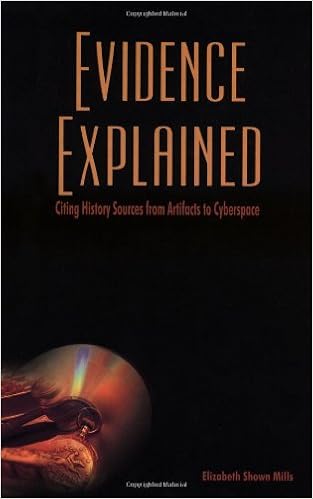
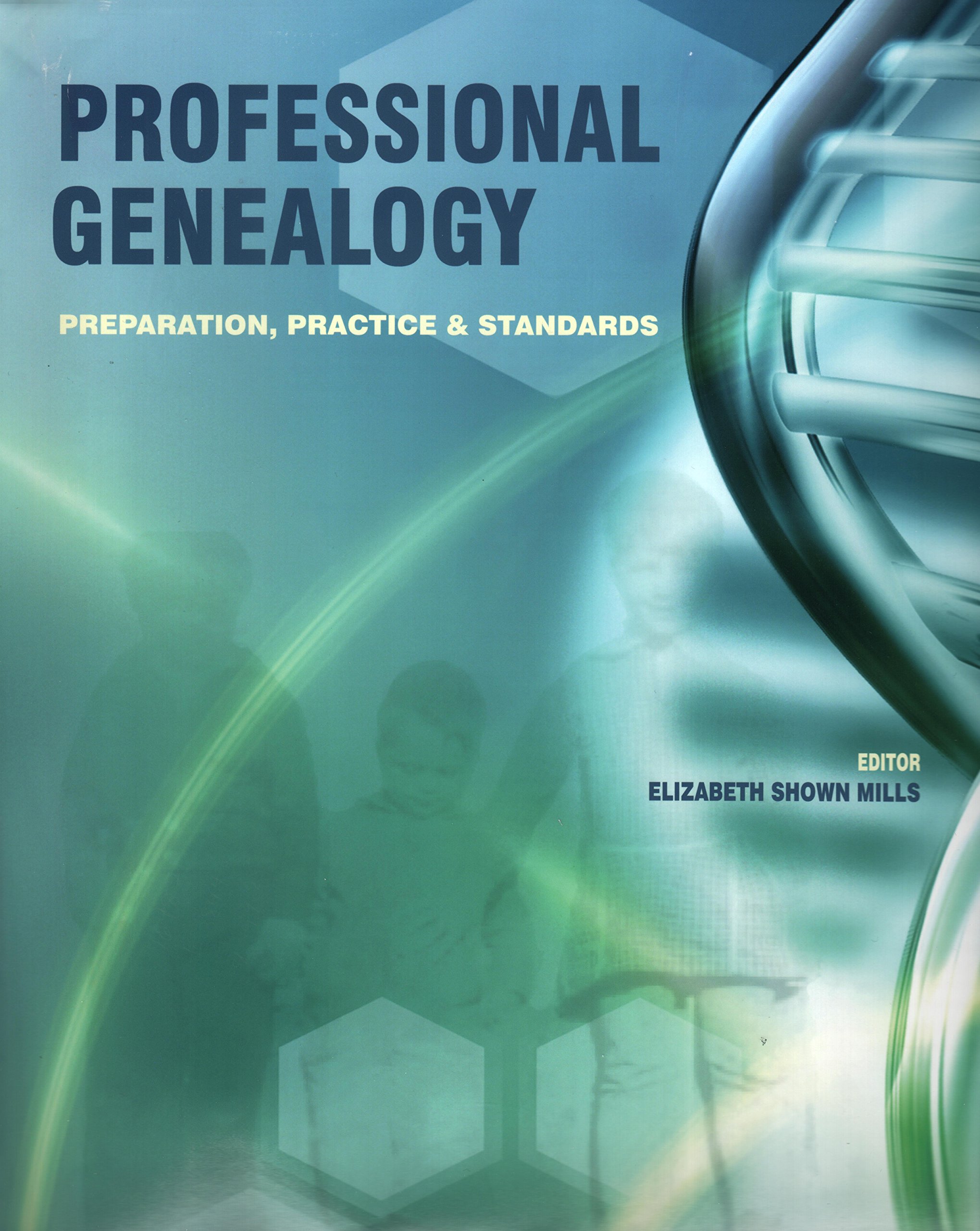
When I decided to start my career as a professional genealogist in 2017 I had a great grasp on how to do genealogy research but I had a lot to learn about being a professional. I read what was available online about becoming a professional genealogist and reviewed available reports. Joining professional genealogy groups and attending continuing education has been very helpful as well. Yet the biggest help overall have been two books; Professional Genealogy: Preparation, Practice & Standards and Evidence Explained by Elizabeth Shown Mills.

I had bought Genealogy Standards before I decided to go professional, which gave a great baseline on how to conduct research, but didn't really go into anything about the in-and-outs of the actual profession. I first decided to get Professional Genealogy: Preparation, Practice & Standards (ProGen) after reading an article by Judy Russell, the Legal Genealogist,  about the release of the newest version. I had heard about the book but had gone a little over a year without it. The reports I prepared for clients went over well and the information was conveyed nicely but I just always felt like they could be better. I had built them based on the reports I could see through samples from BCG and my membership through APGen but there wasn't a lot of explanation as to why everything was done as it was.

Once I received the book I went through it and began to redo the reports I was currently working. To say it was helpful is a huge understatement. Not only did the book explain what choices were available for different situations but it also gave great examples. I have felt much more confident with the reports I have been writing and they look much more professional. Besides help with reports ProGen also goes into all sorts of information on having a career in genealogy; legal information, ethics, career management, and much more.

I bought Evidence Explained a little later after being contacted by a genealogy company interested in working with me. They suggested I look into the book as they preferred to use specific citations which are defined in the book. I got a sample of it on the kindle app and was instantly blown away at how detailed it was on how to build citations. I quickly got online and bought the book. The hardest part of doing citations in genealogy is the fact that there are so many types of documents from so many types of sources, so using guides online are difficult because there are lots of situations they don't take into account. Evidence Explained goes into a bunch different types of situations, gives multiple examples for most situations, and has a great index and chapter listing that allows for quick lookups when you have something you need to find. It has made creating citations much easier all around.

For anyone who is looking to become a professional genealogist or who is looking to advance your career, I highly suggest getting these books. 

Sunday, July 29, 2018

The Ninth Waxman

In researching my Waxman family from Tulchin, Ukraine I have been able to connect almost all of the family, including connecting with the living generations of my Great-Grandmother's siblings. Yet there is one missing piece that is still unknown...the ninth sibling.

Isaac Waxman and Sarah Remer arrived in Philadelphia with most of their children in 1904 and almost all of them were still living in the same house by 1910. Of the children of Isaac and Sarah I knew about eight of them; Zisel Artzis, Katie Shore, Samuel Waxman, Hyman Waxman, Charles Waxman, Pearl Ross, David Waxman, and Fannie Shubert. Yet the 1910 census clearly states that Isaac and Sarah had 11 children with 9 living, so there is a ninth sibling unaccounted for in my research. I have yet to find the immigration documents for Isaac or Sarah, which would hopefully give more information, although the Census records seem to indicate neither naturalized.

There are a few possibilities as to where this unknown sibling was living. They may have stayed back in Tulchin, they may have immigrated later, or they may have even been the first to immigrate. The oldest known sibling, Zisel, immigrated with her husband and children a few years after the rest of the family, so we already know the family hadn't all travelled together.

One clue is the death record for Isaac Waxman, which lists the informant on the record as an M. Waxman. Looking at the tree around the time Isaac died there are no adults in the family who would have been an M. Waxman (including the wives of Isaac's sons), so it is my belief that this M. Waxman may be the 9th sibling. I have since looked at many searches for Waxmans living in Philadelphia with a first name starting with M, both male and female, but have yet to turn up anything fruitful. Over time this mystery may become resolved, especially if we can find more records of the family from Ukraine. 

Monday, July 3, 2017

GeneaVlogger: A New Web Series

For those who have followed this blog closely you may have noticed that things have been quiet for a long time now. While my last post was in September of last year, I have continued my genealogical quest although focusing on some branches other than my Sephardic heritage. Specifically I have been focusing on an Ashkenazi branch of my family which came from Russia to southern New Jersey to be one of the original families at The Alliance Colony in 1882. This research led to me using my videography skills (little known fact about me, I have a minor in Film along with my BA in communications) and brought forth the idea of going from blogging to vlogging.

After a little work creating a basic setup for the idea I am now happy to introduce my new youtube channel - GeneaVlogger. I will be releasing a new Vlog and a new quick tip each week. As much as I enjoy blogging, a video format gives me room to explore a lot more and be more artistic with what I create. I will definitely post more articles here, so don't expect this to be the death of the blog,  but now you have a whole other format to enjoy my research!

Wednesday, September 28, 2016

The Consideration 4: Starting the Process for Portuguese Citizenship

Since I posted The Consideration 3 I was contacted by a few cousins asking for help in the process in obtaining citizenship in Portugal. While I have yet to start the actual process I have begun obtaining the needed documentation. One of the first cousins to contact me had already found a translator to work with and was seeking my help to flesh out the exact details of our lineage from Portuguese Jews who were kicked out due to the Inquisition. So we set out to detail our lineage and prove our ancestry.

The first thing to do was go through the regulations set in the law by using an unofficial translation which also describes the history of the Inquisition in Portugal as well as common Portuguese surnames used by Sephardic Jews. I made a list of all the surnames which matched families on our tree and then began going through each branch documenting the exact lineage. Once the document is complete we will match documents to it for each line. A lot of this is most likely overkill but we also see it as something that many cousins can use as thousands, if not tens of thousands, of people descend from the ancestors talked about in these documents.

I recently found a website called SephardicJewsPortugal.com which details what is needed quite nicely. On the website they describe three ways to prove your descent -

1 – Documented evidence. For example, family records, family tree, community archives of births, marriages and deaths (such as those in Amsterdam, Bordeaux, Curacao, St. Thomas and Sofia), cemeteries and lists of tombs (like those found in Surinam, Thessaloniki, Amsterdam, Hamburg, Curacao, Bayonne, Paris and Vienna), brit milah records, general Government archives that show arrivals from Portugal, lists of ships and passengers arriving from Portugal. It is a criminal offense to falsify documents. The Committee of the Jewish Community will always strive to ascertain the veracity of documentation submitted, which will be evaluated together with the other evidence obtained during the course of the investigation.
2 – Testimonial evidence, ie, reputable witnesses who can attest to a family’s oral tradition. Testimonial evidence must be submitted in writing. Testimony must be in the form of written depositions, signed by the witnesses and certified by a Notary Public  (languages: Hebrew, English Spanish or Portuguese). The depositions must be sent to us together with copies of passports or ID cards of the witnesses. Witnesses must be credible and their testimony convincing. It is a criminal offense for a witness to falsely testify in writing to any legally relevant fact. The Committee of the Jewish Community will always endeavor to ascertain the credibility of depositions, which will be evaluated together with other evidence and information gathered during the course of the investigation.
3 – Expert evidence, ie, support of an expert on Portuguese Jewish diaspora. Expert evidence must be submitted in writing. The reports of experts in Portuguese diaspora (languages: Hebrew, English Spanish or Portuguese) must be in writing and signed by the expert(s).

Besides proof of lineage you must also supply other documents which basically prove you are who you claim to be. The first thing you should obtain is a certificate from the Jewish community of Portugal. There are two communities in which you can obtain this certificate - Lisbon and Porto. A cousin who has already completed this part of the process said that he went through The Porto Jewish Community and it took them about a week or two to accept his claim. I emailed the Porto Community inquiring about what they ask for and their response was short but straight-forward - "Please send the documentation in pdf, send copy of passport, birth certificate, surnames of parents and grandparents and proof of Judaism."


Next you will need to get a translated and legalized Birth Certificate, a certified copy of your passport, a copy of your criminal record from every country in which you've lived, and a Power of Attorney letter from a Portuguese Lawyer. The Porto community even suggests contacting legal representation as soon as you receive the certificate from them. If the application is rejected you will need a lawyer with previous knowledge of your case to properly appeal otherwise you could lose your eligibility to obtain citizenship through this law. They even suggest a law firm called Yolanda Busse, Oehen Mendes & Associados who actually lists an office in Porto and Lisbon. 

Now this process is not cheap, so be prepared for some serious costs. The legal costs I've heard being spent have fallen between $700 - $800 (600-700), although different lawyers will have different costs. On top of that you have the costs of the documentation and translation of documents which could easily become a couple hundred dollars or even more depending on where you have to order the documents from. To give you an idea, in my own case it would cost me $25 for a copy of my birth certificate, about $35 for my criminal records (I lived in two states since I was 18, so I assume one from each), $195 for my passport (assuming you need a new one or to renew it), and I'm assuming about $20 in postage fees, notary fees, and gas. That comes to a total of $275 for me but I'm guessing it could be a lot more for others, especially anyone who has lived in a lot of states or multiple countries. I have also heard tell that a donation to the Jewish Communities is encouraged of around 500 (about $550) to help with upkeep and sustain the work to prove Sephardic ancestry for applicants. This comes to an estimated $1,625 for the total costs associated with the application, at least in my case, and could easily be even more. 

The costs may not end there for some as certain countries charge extra taxes for dual citizens. If someone from the United States received their Portuguese citizenship and went abroad to work they may be taxed in the United States on any income earned abroad (learn more here). This is somewhat similar in the UK (learn more here) but for many of those in Britain I'm sure this is a much more enticing opportunity as Portuguese Citizenship will allow you to retain a European Union passport.

For anyone who is going through the process or has completed the process I'd be quite interested to hear about your experiences. Please use the message form.

Read the Previous articles;
The Consideration: Obtaining My Spanish Citizenship As A Sephardi
The Consideration 2: A Step Forward For Obtaining Spanish Citizenship
The Consideration 3: Spain and Portugal Pass Sephardic Right To Return:


Thursday, August 18, 2016

The Story of Chuts: How Cigars Saved My Family

In the 19th century my Dutch Jewish ancestors decided to move from Amsterdam to London. My first ancestors to make the move were my 4th great grandparents Abraham Moscou and Schoontje Veerjong in 1867 (although it is disputed if Abraham was around for this move). Most of the family moved to London, including my 3rd great-grandfather Morris Moscou. Morris' future wife's family, the De Haan family, also made the move around this time as they appear in the 1871 England Census living in Spitalfield. By 1881 another set of my 3rd great-grandparents, the Nunes Vaz and Robles family, had made their move to London from Amsterdam.

I had always wondered what caused my ancestors and their siblings to move to London from Amsterdam, a city in which Jews were seemingly able to thrive with very little anti-semitism for hundreds of years. Through the House of Orange and the Napoleonic Emancipation, Jews in Amsterdam were treated better than most other Jews throughout the World. One of the things I noticed about most of my Dutch Jewish ancestors was the fact that they were almost all cigar makers. There were even stories that my Nunes Vaz ancestors worked on the same bench as Samuel Gompers, who helped set the 8-hour workday.

I soon found that while Jews were treated better in Amsterdam than in most other places there were still some anti-semitic laws. Jews were not allowed to join guilds, which would have been something extremely useful to cigar makers, nor were they allowed to own their shops. Seeking better opportunities in their trade my ancestors made the move to London which was a major center for cigar making during the 19th century. These Dutch Jewish immigrants gained the nickname of Chuts, which is often attributed to the Dutch word 'Goed' which means good. They mostly settled in Spitalfields in the East End of London in an area nickname 'The Tenterground', an area originally established by Huguenot refugees.

Many of these Chuts established small workshops and factories for cigar and cigarette making. Many of the shops were situated in Bethnal Green, White Chapel, and Spitalfields, areas that are all close to the Tobacco Dock in Wapping. Tobacco would come in from the United States and sold to the jews who then treated, stripped, and processed into cigars and cigarettes. The cigars the chuts made were known as "British Cigars" and were considered of high quality.

With the progression of technology and machinery in the late 19th century the cigar making jobs in London became less available and caused many Dutch Jewish families to immigrate once again around the turn of the century. While some of these Jewish families went back to Amsterdam many either stayed in England or immigrated to the United States, Australia, or New Zealand. The United States was going through a golden-age of cigar making and there was a lot of available work. My family decided to move to the United States for stability but they were also bringing safety to their descendants. My family's decision to pursue the cigar making industry in the United States ultimately led to the safety of my family. Not only did this decision to officially move to the United states save them from enduring the bombing of London, which so many of our English relatives suffered through, but it also saved the family from the fate of the many relatives in Amsterdam who were murdered in the Shoah.

There is a family story which comes from the early 20th century when my 2nd-great grandparents were trying to decide whether to stay in London or move to Boston. My 2nd-great grandfather had been pursuing a career in London as a vaudevillian actor and dancer under the name William H Macknay and liked it much better in London. The family had already been to the United States, having lived in Michigan and Boston, but went back to England because my 2nd-great grandfather didn't really like it in America. During an argument about where to live my 2nd-great grandmother told her husband "In England we starved, this is the country that gave us something to eat." They went to America where the family flourished, safe from the horrors so many of their relatives endured. 

Sunday, October 25, 2015

Digital Genealogy and Privacy Issues

For anyone in genealogy who has invited relatives to view their tree online it is likely they have run across a few relatives who were less than pleased with family information being published online. I once had a cousin actually threaten to sue me if I didn't take the tree down (referring to geni.com). For genealogists who are constantly reaching out to new found relatives this can be even more prevalent, especially if the family being contacted have had identity theft problems.

This summer at the 35th Annual Conference of the International Association for Jewish Genealogical Societies in Jerusalem, Randy Schoenberg presented his lecture "Privacy Issues with Online Family Trees" in which he discusses why there is little to fear when it comes to digital genealogy. He methodically and logically breaks-down the idea of privacy rights and how they apply to genealogy just as they do in every day life. In his introduction Schoenberg states -


"The right to privacy is a relatively recent legal construction, and one that is still evolving. As genealogists, people whose goal is to learn and write about personal details of other people, we often hear complaints about invasion of privacy. So it is worth exploring the issue in some detail to understand what rights exist at present and what might evolve in the future. Since much of our work is done online, I will also address privacy issues related to online trees on various platforms."


Click here for the published version of the lecture

Thursday, October 15, 2015

First Relative Found Through DNA

Just over 2 years ago I ordered the Full Genome Kit from Family Tree DNA. This included a Y-DNA 67 Test, a Full Mt-DNA test, and an Autosmal DNA test (known as Family Finder). My main goal with these DNA tests was to learn about my paternal ancestry, something that I knew little about, as well as locating relatives. When I finally received my results I was stunned at the amount of matches I had in Family Finder and every surname in my Y-DNA matches had completely different surnames, both being quite common results for those with Jewish ancestry.

I found a handful of relatives who I had already found through the paper-trail but it was nice to have DNA confirm what old documents told us. I couldn't find anyone linking into my tree otherwise and throughout the years have contacted different matches in hopes of finding the link. The big hope was to find someone who not only linked into my tree but had more information than I did on the family. I expected the first person I would find to be a 3rd-5th cousin because I've known a lot of about my 1st and 2nd cousins (assuming no one has hidden an illegitimate child).

Finally after 2 years I found a match who had a not so common Jewish surname which was also in my tree. As well they had listed that family being from the UK and Holland, which basically confirmed it for me there because I have yet to find any families in Holland with the same surname. After contacting the relative and explaining what I knew she responded and told me that her sister had focused on researching that side of their family but she knew there was little information of where their side came from. After looking up the names she sent me for their most distant ancestors on that line I was able to find her great-grandfather in my tree. 

After adding her in and doing some quick calculations I realized that she was my 8th cousin exactly. I would have never imagined that the first relative I found through DNA would be so distant in relation. Our most recent shared ancestors were born in 17th century Amsterdam. Although I should also mention her sister had taken a DNA test but we did not match. Either way, it's great to finally have found a relative through the use of DNA and hope that I find more success in the near future.

Buy a DNA test
Family Tree DNA - https://affiliate.familytreedna.com/idevaffiliate.php?id=1614
23andMe - https://amzn.to/2K57c9j
Ancestry DNA - https://amzn.to/2K3ewSM
MyHeritage DNA - https://amzn.to/2M0bhgu

Sunday, October 4, 2015

Origins of the Nunes Vaz Family of Amsterdam

The Nunes Vaz family of Amsterdam traces it's documented roots back to Livorno, Italy in the late 17th century. Jacob Nunes Vaz is the patriarch of the Nunes Vaz family of Amsterdam and was born in 1697 in Livorno, Italy to Abraham Nunes Vaz. Jacob's father Abraham was born around 1670 but there have been no records found on Abraham. It is believed the family originally hailed from Portugal and there is even a family story that there were originally 4 Nunes Vaz brothers who left Portugal and all went to different parts of the World.
Marriage Record for Jacob Nunes Vaz (1697-1746)
and Judith Falcao (1703-????) - Dec 23rd, 1723

Back in Italy the name also was spelled as Nunes Vais and some records in Amsterdam even spell it as Nunes Vaes. It doesn't seem like anyone else from the Nunes Vaz family came with Jacob to Amsterdam, although there is a possible sister named Lea who is listed in the cemetery records at Beth Haim as Lea Nunes Vaes of Esther and died in 1748, 2 years after Jacob. I haven't found any records of an Esther but I suspect it's possible Esther is the wife of Abraham Nunes Vaz, which if so would make Lea the sister of Jacob and Esther his mother. The family left back in Italy became quite prominent with many Rabbis and famous artists including Italo Nunes Vais and Mario Nunes Vais. The patriarch of the branch that stayed in Livorno is Isaac Joseph Nunes Vais who died in 1768 and was most likely born around the same time as our Jacob Nunes Vaz. It is my belief that Isaac Nunes Vais and Jacob Nunes Vaz were 1st cousins who shared Nunes Vaz grandparents, making their fathers brothers (but this is all speculation). Even more interesting is the fact that both Isaac and Jacob were printers, making it possible that printing was a family trade.
Record for Raphael Nunes Vaz (1734-1802) at
Beth Haim of Ouderkerk aan de Amstel

Jacob Nunes Vaz married Judith Falcao on December 23rd, 1723 in Amsterdam and they had two known sons; Aaron (1733-1745) and Raphael Nunes Vaz (1734-1802). Jacob worked as a printer and it is believed his father also worked as printer, most likely gaining their skills in Livorno which was considered the center of Hebrew printing in Italy. Jacob died in 1746 at the age of 49. Jacob's son Raphael Married Simcha Querido on November 10th, 1758 and had a lot of children but because Jacob's other son Aaron died at the age of 12 all members of the Amsterdam Nunes Vaz family trace their roots back to Raphael.

Of Raphael's descendants all of them come from two of his son's; Jacob Nunes Vaz (1759-1813) or Abraham Nunes Vaz (1769-1832), both of whom marred women from the Senior Coronel family. Between these two brothers there are more than 3000 known direct descendants with about 1000 living descendants scattered all over the World. The number seems to constantly go up as more descendants are found but because of the horrors of the Holocaust, especially in Amsterdam, many branches in the Nunes Vaz tree end in the 1940s.

A portrait of Jaap Nunes Vaz
painted by his friend Meijer Bleekrode
One famous figure in the family is Jaap Nunes Vaz, a co-founder of the newspaper Het Parool and a member of the Dutch resistance. He was arrested by the Gestapo on October 25th, 1942 and deported via Westerbork to Sobibor where he was murdered on March 13th, 1943. He has a street named after him in Amsterdam. 

Wednesday, August 19, 2015

Quantifying Genealogy

As I have progressed on my genealogy journey I have constantly wondered of ways to quantify how much I know about my own genealogy. Was there a way I could determine how much of my family history I knew? After looking at random statistics and doing different calculations there were two things I found very interesting in terms of quantifying my genealogy; the number of ancestors I knew about (at least a name, a birth date, or a death date) per generation back and the total number of ancestors I truly had in each generation. I could easily put these together to find out an assumed percentage of how many ancestors I knew about in each generation. I decided to make a post about it although it could be considered rambling by some.

Here is what I have in basic knowledge for up to 8 generations

Parents - 2/2 = 100%
Grandparents - 4/4 = 100%
Great Grandparents - 8/8 = 100%
2nd Great Grandparents - 12/16 = 75%
3rd Great Grandparents - 12/32 = 37.5%
4th Great Grandparents - 8/64 = .125%
5th Great Grandparents - 15/128 = .117%
6th Great Grandparents - 24/256 = .094%
7th Great Grandparents - 41/512 = .08%  
8th Great Grandparents - 65/1024 = .063%

Looking over it this seems pretty straightforward but when you interpret what it means it really puts things into perspective. For example lets take my 8th great grandparents who were all mostly born between 1650-1700, about 365 to 415 years ago, I know about only 65 completely different ancestors living at that time. Yet those 65 almost make up 2/3 of only 1 percent of the ancestors I had alive at the time throughout the whole world. As well it shows just how much information I lack and how much there is for me to try to obtain, so it gives me inspiration to knock down those brick-walls to discover all that information I don't know about the ancestors I come from.

Now if I go back two more generations things get very interesting because this is the first generation where I know I have ancestors show up multiple times.

9th Great Grandparents - 59/2042 = .029%
10th Great Grandparents - 43/4084 = .011%

If you look closely you will realize that instead of 2048 9th-great grandparents I only list 2042. This is because I have 3 sets of 9th great grandparents who I descend from twice. Each subsequent generation back in time will now go from this number until another generation with ancestors who I descend from more than once changes the number again. I find it an interesting concept because it relates to the pedigree collapse theory, that over time you will eventually have more ancestors than people living in the world. So lets say you have a set of 2nd great grandparents you descend from twice you would have 14 sets of 2nd great-grandparents instead of the usual 16, then take that back 5 more generations to 7th great grandparents and you've got 456 ancestors at most instead of 512, a difference of 56 ancestors. Take it back to your 10th great grandparents and you've got at most 3648 ancestors instead of 4096, a difference of 448 ancestors. Then once you consider that each generation you go back there is an even higher likelihood of more common ancestors within your own tree the actual number of ancestors you descend from could be quite less than you truly anticipate. 

Wednesday, July 15, 2015

Politically Correct Transparency: Ben Affleck and Finding Your Roots

One of the most disappointing things in the genealogy field lately is the whole Ben Affleck debacle with Finding Your Roots. It is one of the most publicly talked about genealogy related discussions since the article about 'every president but one descends from John Lackland'. For those who are unaware of what happened Ben Affleck was a guest on the 2nd season of Finding Your Roots, a show hosted by Henry Louis Gates Jr. featuring the ancestry of all types of celebrities. During Affleck's segment he discovered he descends from slave owning ancestors. After the filming Affleck contacted Gates and asked that the slave owning ancestors be left out of the final cut, which was the final result. Fast forward a few months later when a massive leak of emails brought this to light and people began to cry foul over the decision to omit the information about Affleck's slave owning ancestors from the episode. After an internal investigation on the matter PBS decided to postpone airing the 3rd season, initially set to air in September, citing Affleck's 'improper influence' and would not reschedule the airing until the show did staffing changes including the addition of another fact-checker and an 'independent' genealogist. As well a possible 4th season is up in the air and PBS will yank the episode with Affleck from future airing. 

Now for my opinion...

It is such a shame as Finding Your Roots is the best genealogy show out there. Much better than any of the Who Do You Think You Are programs, most especially the US version. And for it to all be knocked-down in the name of politically correct transparency because one guest out of the 30+ asked to keep his slave-ancestor out of the program. I'd be curious to see how many people who are so up-in-arms about this who have actually watched this show, let alone this specific episode. One girl I know posted a very berating post about the subject, claiming that had it not been omitted from the show it could have started a discussion about the history of slavery in the United States. To me this shows she has never seen the show because not only has Finding My Roots discussed the history of slavery in the United States at length but every Henry Louis Gates Jr. program has investigated the history of slavery in America more than any other historical or genealogical subject. As well it was a good episode and now they are yanking the episode without consideration (as far as I can tell) to Ben Jealous or Khandi Alexander, the other guests featured in the episode with Affleck. The shows lack of inclusion about his slave-owning ancestors took away nothing from the episode as it was full of interesting information. 

Anyone doing genealogy also knows that there is an absolute abundance of information learned when doing a tree, especially starting from scratch, and to cut all that down into 1/3 of an hour long program leaves a lot out. Not only do they have to condense all this information into 20 minutes but they have to also include the introduction of the guests, talk about their childhood and immediate family, and discuss the DNA of each guest (although some episodes have left out the DNA for some guests), leaving less time to discuss each guest's ancestors. Knowing there is such a small amount of time in each episode, how do we know Affleck's slave owning ancestor wouldn't have been left out without his request? Maybe it wasn't that interesting of a section other than the fact that the ancestor owned slaves and being Affleck requested this info to be out they figured it wasn't a big deal to leave it out (I would do the exact same thing had this been the case).

Seems to me that all these people jumping on the 'hate band-wagon' are hurting the potential this show gives genealogy. Programs like this can actually inspire people to look into their family histories and become interested in genealogy. And as a young man who enjoys genealogy a bit too much I know first-hand how few people my age - and younger - show an interest in the subject. With that said, I'm curious as to what is to be gained by this witch-hunt against Ben Affleck and Henry Louis Gates Jr.? I understand the show should be held to a high standard, especially being a show that prides itself in uncovering historical information, but they never falsified any information so I don't see what is to be gained from this. What are people looking for other than the sheer drama of calling people out on supposedly 'not doing the right thing'? And another question, would people have cared so much if a guest had requested to leave information out on an ancestor being connected to something else such as the Donner party or descending from a tory family? 


In the end I think most of the people complaining really don't care about the show and just want to be part of an angry mob. Today PBS announced the 3rd season would now be aired in January but didn't mention a possible 4th season. One thing I've found interesting is the lack of input from other guests from the show. After two seasons with two to three guests a show as well as a myriad of other famous guests on Faces of America and African American Lives 1+2, it's surprising no one has spoken up for Henry Louis Gates Jr. Especially when you are talking about celebrities like Oprah, Chris Rock, Stephen Colbert, Corey Booker, Ben Jealous, Anderson Cooper, and so many other people who make a living talking and discussing topics of race and politics. Maybe they are scared of the politically correct social media machine which seems to have made such an impact in our society today that it destroys careers and families within mere hours of post. But in the end that's what this seems to be about, politically correct transparency. 

Friday, June 20, 2014

The Race Debate: Is there a Jewish race?

When I was in college I took a class called Jews in The United States. Obviously the class was focused around how Jews lived in the USA, but early on our professor Barbara Burstin brought up a question I had barely thought about; Who is a Jew? The class discussed multiple ideas of defining who is a Jew; someone born to a Jewish mother, one who practices the Jewish religion, one who descends from the 'Jewish People' (a.k.a. a Jewish race). What really stuck out with me is the idea of Jews as a race. At that point of the class I was a year into my serious genealogy research and had just begun to trace out my Ashkenazi roots in Holland, something I thought I'd never find from my Dutch Sephardic line. As well I had just learned about the Joods Monument, which I wrote about here. I was slowly realizing how connected the Jewish population around the world truly were, so the idea of the Jewish race just made sense to me.

When the class discussed this idea further I realized that many other Jews and non-Jews were quite against this idea. Some discussed how this was just anti-semitic and could lead to another Holocaust because the idea of Jews as a race is used by anti-semites in their propaganda. What the anti-semites do is use the argument of a Jewish race to say Jews have been bred to be evil and manipulative. I could understand why this would lead to many rational people saying the idea of Jews as a race is not only wrong but is morally wrong, especially when you read articles like this, but I think if you look at it with fears aside (there will always be crazy people in the World) you can see the proof in genetics. Another argument that was difficult to counter is the idea that Judaism is a religion and people leave or convert Judaism all throughout history, thus Jews couldn't be a race. While this argument is valid in a way, if you look at it in a different way it makes more sense why this is wrong (at least in my humble opinion).

The first thing you need to do is think of Judaism in two lights; the religion and the race. Yes, as two different things. To make this easier I will refer to the religion as Judaism and the race as Israelites. Judaism is just a religion anyone can enter or leave based on their personal beliefs. Israelites are those who descend from the people who lived in the Middle East who practiced the Jewish faith. So to be an Israelite would be your genetics consisting of mostly Israelite markers. What kept the Israelite DNA flowing throughout it's own community was the Jewish faith, a societal barrier which kept marriages within the Jewish community. Even after hundreds of years apart many people from around the world who claim themselves to be Jewish share a common descent which has been shown through DNA.

Anyone with a percentage of Jewish Diaspora genetic markers (what I previously referred to as Israelite markers) on Family Tree DNA could tell you how fascinating it is to see the thousands of Jews who are anywhere from 2nd cousins to 5th or 6th cousins. Most of whom rely on the chromosome browser to determine how they are related to the others. On Family Tree DNA in the My Origins section of Family Finder they talk about the Jewish Diaspora and say "While Judaism is a religion, the Jewish people are also a nation. Modern Jews have diversified into numerous branches, such as Ashekenazi, Sephardic, and Mizrahi, as well as odds and ends such as the Bene and Beta Israel. Unifying many of these populations are genetic commonalities, likely resulting from a common Middle Eastern Ancestry. This combination of Middle Eastern and European is found in many other groups, and many of them exhibit signatures of the Ashkenazi Diaspora, but it is not common descent."

Interestingly enough I see a correlation of this idea with a Muslim race but the World already refers to them as the Arab race. At this point some of you might say, "But there are a lot of Arabs who are Jewish, Christian, or other religions and a lot of Muslims who aren't Arabs." True but you can say the exact same thing about Israelites as there are hundreds of thousands who have converted to Christianity, Islam, and other religions over the past 5000 years as well as lots of Jews who aren't Israelite. I would even bet that many Christians with newly discovered Jewish ancestry are reading this, especially since it is more common for those with Sephardic ancestry.  I found out from my own DNA test that I am 6% Arab, meaning that one of my 2nd great-grandparents could be fully Arab (there are only three of my 2nd-great grandparents I don't know about, so possible) but at the very least I have a multiple 3rd great-grandparents and other ancestors further down with partial Arab blood.

In the end I think the main point I'm getting at is when it comes to "Is there a Jewish race?" the answer is Yes. If you look at it from a completely scientific standpoint based on genetic evidence you can see there is an abundance of proof that points in the affirmative.

Buy a DNA test
Family Tree DNA - https://affiliate.familytreedna.com/idevaffiliate.php?id=1614
23andMe - https://amzn.to/2K57c9j
Ancestry DNA - https://amzn.to/2K3ewSM
MyHeritage DNA - https://amzn.to/2M0bhgu

Tuesday, June 10, 2014

The Consideration 2: A Step Forward For Obtaining Spanish Citizenship

Just a few days ago the Spanish Cabinet officially approved draft legislation allowing people with Sephardic Jewish ancestry to obtain dual citizenship. They have added one caveat to the process which requires the person to not only prove their ancestry but they must also pass a Spanish Culture Test. What that exactly entails they have not released but it is being prepared by the Cervantes Institute. The legislation cannot be implemented until approved by the Spanish Parliament which is controlled by the  conservative People's Party who strongly support the legislation, so it will most likely pass.

Some are lauding the move as a way to right the injustice of the Spanish Inquisition. But there is another voice which has emerged forbidding Jews to obtain Spanish citizenship. Rabbi Shlomo Aviner and other senior rabbis urged the Jewish people to reject the offer. Their main argument is they believe Spain is using this for political reasons to "make up for the expulsion of the Jews." Rabbi Aviner also spoke about the financial gain Spain is looking to gain because of their need for support, even claiming "An Israeli passport is worth more."

After my first post about looking into obtaining citizenship once available I heard from a lot of people about their opinion and many said things quite similar to Rabbi Aviner. Some even said they felt that Jews looking to move abroad should consider Israel over Spain since it is the Jewish Nation. Rabbi Haim Drukman had similar statements earlier this year, "We are privileged to have our own country and we should be proud to be its citizens." It is an interesting notion but one many non-religious Jews would not agree with, especially those who don't want to serve 2 years in the military or are afraid of the current fighting situation.

Leading Sephardic Rabbi Eliyahu Abergil reminded the Jews that there is an ancient cherem (religious ban) which was decreed after the Inquisition. A topic which I've heard about since I began my research on my Sephardic ancestry.

At this point I couldn't move forward with obtaining citizenship because I have to wait for Spanish Parliament. Yet the question I have to really ask before I move forward is, "What do I gain out of it?" Obviously it would be really cool to have dual citizenship but there are negatives and a lot of unknowns with possible situations that could arise, especially anything legal. One of the best positives from getting Spanish citizenship is becoming a member of the European Union, basically giving me access to live, work, and study in any EU country. EU membership has a lot of other perks whether I'm traveling throughout the EU or I decide to live there. Beyond this the only other thing I'd gain, I assume, is the ability to participate in Spanish politics.

There is certainly a decent amount to consider and many people have already decided they won't go through with it if the bill passes. Yet there are many more who are still quite interested and see this as a big opportunity. At least I have time to figure it out.

Read the Previous and Follow-up articles;
The Consideration: Obtaining My Spanish Citizenship As A Sephardi
The Consideration 3: Spain and Portugal Pass Sephardic Right to Return
The Consideration 4: Starting the Process for Portuguese Citizenship

Saturday, February 8, 2014

The Consideration: Obtaining My Spanish Citizenship as a Sephardi

I have been thinking about becoming a Spanish Citizen. Due to my ancestry I will be able to do so quite easily without losing my current citizenship in the United States. I'm just not yet sure if I want to go through with it, so I have been researching it quite extensively.


There has been a buzz for a few years now about people of Sephardic descent being able to obtain citizenship in Spain without having to denounce their current citizenship. Just the other day on the 7th day of February in the year 2014, the Spanish Cabinet passed a new law giving a 2 year window for descendants of Sephardic Jews to apply for fast-tracked citizenship. While this law is finally coming to fruition it has been in the works for many years now. 

In 1992, King Juan Carlos prayed at Beth Yaacov Synagogue in Madrid to commemorate the 500th anniversary of the Alhambra Decree. King Carlos then declared "Sefarad is not nostalgia but a home which should not be said that Jews feel at home, because the Spanish-Jews are at home. What matters is not accounting for our mistakes or successes, but the will to project and analyze the past in terms of our future." In 2012 at a ceremony at Madrid’s Casa Sefarad-Israel the Justice Minister Alberto Ruiz Gallardón announced the Spanish Government would be opening automatic citizenship for anyone who could prove they descended from Sephardic Jews. 

There was a major problem with the 2012 law which made it impossible to work. It required a Certificate from the Federation of Jewish Communities of Spain (
Federación de Comunidades Judías de España) but the Federation refused to give out certificates until the Spanish government defined what documentation an applicant required to be considered Sephardi. Just over a year later the Federation of Jewish Communities of Spain are now praising the law passed by the Spanish Cabinet. A statement they released about the law said “The minister of Justice, Alberto Ruiz Gallardon, kept his word, and this honors him. Spain, once again, not only did not disappoint, but made a historical step for the Sephardic Jews”

The new law still must pass the Spanish Parliament before being officially implemented. While the law speeds up the process it still has stipulations which must be met. The law entails that the applicant prove they are Sephardi by one or more of the following requirements;

1. A certificate from the General Secretariat of the Federation of Jewish Communities of Spain saying the applicant is of Sephardic origin.

2. A certificate from the Rabbinical Authority legally recognized in the country in which the applicant resides.

3. Family names, languages, or other evidence of applicants connection to the Sephardic Community.

4. If said person was included in a list of Sephardic families protected by Spain such as the decree of December 29th, 1948 or those who obtained special naturalization through the royal decree of December 20th, 1924. 

5. The applicant can prove linkage to person or family member who the previous stipulation applies to.

6. In the event the application is sent to the civil registry office in charge of the residence of the applicant it will consider any applicant's sign of belonging to the Spanish community in their area.


If one or more of these stipulations are met then the applicant must also provide a statement of loyalty to the King of Spain and obedience to it's constitution and laws. The acquisition is then recorded in the Spanish Civil Registry. 

Now the question comes about of whether or not to go through with this...

If you would like to read the actual law please click link (warning: automatically downloads .pdf and is in Spanish);

Sunday, June 23, 2013

Basics of Exploring your Family Tree on Geni

Over my few years of doing genealogy I have found only one website which I feel the need to pay a membership; www.geni.com. There are a few reasons why I enjoy this website so much; The format of the website makes it much easier to find matches, exploring the tree is very simple, and it is easy to get down. When I first began my research I tried to build a small tree on Ancestry.com but found in my trial of the website that it was quite confusing just to get in contact with a relative. I also hated the format of the tree because it kept it in a two-dimensional format. While there may have been changes over the years since I last used ancestry I quickly found that geni.com gave me the tools I needed.

As many genealogist come to find out quite quickly, family trees are not 2, 3, or even 4-dimensial. They are infinitely dimensional; each person has a tree unique to only them with only a small percentage of their tree similar to those of blood origin (similar to the amount of shared DNA between relatives). The program geni.com has created for their tree format allows you to easily move from one dimension of the tree to another dimension of the tree. The basics of the tree are pretty easy to understand and the tutorials on this are plenty (a good video for beginners http://www.youtube.com/watch?v=I4VkZHcNu1o), but there aren't a lot of tutorials or explanations about how to explore and edit the tree beyond the basics.

So assuming you have a basic working knowledge of geni (if not, watch the video above and spend some time on the site to get a basic understanding), I will go into some simple features many people overlook.

Nodes
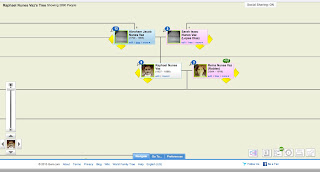
When you first open the tree window you will automatically be the focal person in the tree. For our example we will use Raphael Nunes Vaz. Within the tree each person is represented by what is called a 'node', with multiple links available at the bottom of  each node. Clicking the "tree" link on a person's node will make them the focal point of the tree. Each node will have yellow arrows pointing either up, down, left, or right. Clicking an up arrow will add a parent, clicking the down arrow will add a son or daughter, clicking the left or right arrow will add a sibling or a spouse. Some nodes (such as Reina Nunes Vaz') will also have a small tree above it with a number; the number indicates how many people are in that person's tree who aren't visible in the current tree. Clicking on the small tree above the node will make that person the focal point of the tree.
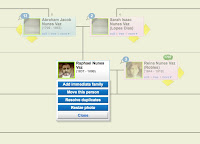
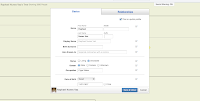

The edit link will cause a pop-up window to appear (pictured on the left) with Basics editing options and Relationship editing for that person. Basics is the automatic window but if you click on the relationship tab you can easily change parents if there is a mistake as well as editing dates and information for any spouses. There is also the option to change the spouse status to husband/wife, fiancè, ex-husband/wife (divorced), and ex-partner. The third link is the 'more' link which will show the following options when clicked (as shown above on right); add immediate family, move this person, resolve duplicates, send message, and resize picture.
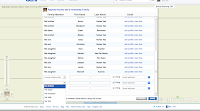

The "add immediate family" link brings up a page (shown on the right) which allows you to enter in multiple immediate family members at once(parents, siblings, spouses, and children) and also allows you to edit the already added immediate family members. The "move this person" link allows you to merge duplicate profiles and clicking the link will cause a mini-window to open with the a duplicate node (shown below), this window with an extra node will stay open even as you select other nodes to become the
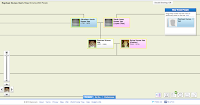
focal point of the tree. Once you have found the duplicate profile within the tree just drag the node from the other window over the duplicate profile. A window will pop-up asking what the relation of the one profile is to the other. The "resolve duplicates" link will open a window which allows you to quickly merge any duplicated immediate family members. Simply drag a duplicate profile over another duplicate and it will link them together. Clicking the "send message" link will allow you to either send a message to the person (if they accessed their profile) or the page manager.


Tree Preferences
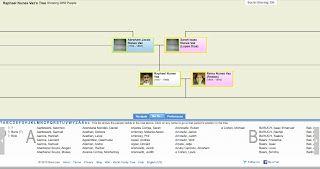

When looking at your tree at the bottom of the page you will notice 3 blue tabs; Navigate, Go To..., and Preferences. The "Navigate" tab gives you an eagles eye view of the whole tree as best possible (shown on the right), allowing you click on the section of the tree you'd like to go to. The "Go To..." tab gives you a list of all the names of the profiles being shown in this setup of the tree.  The "Preferences" tab gives you many different options on how you would like to view your tree.

Display

With the "Preferences" tab there are 4 sections; Display, Names, Revision, and Advanced. Under "Display" you can choose how many generations of ancestors you would like to show and how many generations of descendants you would like to show (it goes from 0-20 and then goes to All). There is also a checkbox for "direct ancestors only". Checking this box will make the view of the tree only show ancestors of the selected person, taking out any ancestor siblings or unrelated spouses from view.
It will still show any descendants of the selected person

In the middle of the display tab are 4 different options of the Tree Diplay; Standard, Vertical, Photos Only, and Names Only. The last options with the Display tab is layout options, each being a check-box; Show Photos, Flip Nodes (this means when you scroll over a node in the tree an information window about that person will pop-up), Click to Flip Nodes (Flip Nodes must be already selected), Show Yellow Arrows (the arrows all you to add family members), Show Email Prompt (will give a space in the node to enter the email of the person if they are listed as alive), Center Single Parents, Mark Deceased, Neutral Color Backgrounds, and Open Profile in New Windows (when selected this opens a new window when you click on a node to look at the person's profile).

Names and Revision

The names link is a series of check-boxes which affects the information given on each node. The options under this link are in two columns; one which you can only select one option, the other with multiple options. The first column affects the display of birth names in the tree; Do not display birth surnames, birth surname instead of last name, birth surname instead of last name in Caps, birth surname appended, in parenthesis (tree only). The second column affects how the name is displayed in each node; Ignore display name, Show Suffixes, Show middle names, Do not guess last names, and reverse RTL names (used for names in Hebrew/Arabic).

The Revision link allows you to change the display of revision history of the tree. You can see the revision history of each profile under the revisions tab within the person's profile page.

Advanced

These options allow you to change the physical view of the tree; Font size, Date format, and Rendering quality. All of these options are more for personal preference, so you can play around with it and see what you like best.

Tips

One of the best ways to really get used to the format is to play around with the tree and try to build it up to the point that you are able to merge with other trees on geni. Just viewing each tree from the focal point of all your different relatives can give you a great idea of how the program works. The help section on geni.com (http://help.geni.com/home) is very helpful and includes a whole community of experienced genealogists.

*A quick side-note that as you get into the more advanced options you may be limited if you have the Basic account. Differences between the types of accounts can be seen here.
Tuesday, December 20, 2011

Dutch Jews Killed in the Holocaust

The Jews of the Netherlands were persecuted by the Nazis using the 
vast array of documents and records kept by the Dutch and Dutch Jews alike. Of the 140,000 recorded Jews living in the Netherlands 107,000 had been deported by Wars end. 30,000 Jews survived by hiding, escaping, or other means and only 5,000 of the deported Jews returned home.

You can find information on these people at the Joods Monument website. If you can research your lineage to Dutch Jews, Sephardic or Ashkenazi, I can almost guarantee you have relatives listed on the website. The basic information provided for each individual is their birth date, birth location, death date (sometimes deportation date which is the assumed death date), death location, and last recorded residence. As well there is very large community of people who add information to this website; things like pictures, documents, stories, if there are living relatives (they don’t give any info on living relatives), biographies, and links to other family members pages also on the website.


For an example we will use the profile of Leendert Nunes Vaz. He was born November 17th, 1906 in Amsterdam and died at the age of 38 on February 16th, 1945 at Westerbork. The left column shows the home address and lists everyone in the household. Right above Leendert’s name on the left you can see a blue bar. This blue bar is part of a color coded bar system the website uses to distinguish who was in the household. Tall blue bars are adult men; tall red bars are adult women. Half-length green bars are boys ages 6 to 21; half-length yellow bars are girls ages 6 to 21. Short light blue bars are boys 6 and under; short pink bars are girls 6 and under. A white bar indicates a member of the household survived the war and could still be alive.

For another example we will use the profile of Alida Lopes Dias. She was born in Amsterdam on Septermber 19th, 1929 and died at the age of 13 on June 11th, 1943 at Sobibor. We can see in her household she had an adult man (her father), an adult woman (her mother), a member who survived and could be living (a sibling), and a girl age 6 to 21 (Alida). Under the bars it says “Leendert Lopes Dias and his family” with a little i in a white box next the text. This is a link to information about the whole  household, with the i in a box indicating there is extra information on that page.

Underneath the link to the household information we see each family member listed (their name is a link to their page), their birth and death info, and their relationship to the head of household. Below that we see “One child living with it’s parent’s survived the war”. In the center column we see that she was on the children’s transport that went to Sobibor via Westerbork. It also lists where that information was obtained. In the right column we see a picture of Alida and underneath private collection. More than likely Alida’s surviving sibling sent this picture to the Joods Monument.

I suggest before you start searching the website to read the introduction, faq, and other subsequent pages to get a better feel for the website. They give a much better in-depth description of how the website works. Everything on the website is spelt the Dutch way; including Hebrew and Yiddish words. The search on the website is pretty straight-forward, just use keywords to narrow what you’re looking for if you are having trouble.

Thursday, December 8, 2011

Friending My Sephardic Family; Using Facebook for Sephardic Genealogy

When I really started digging into my family genealogy I spent hours and hours online. In fact almost all of my research has been spent on the computer because of the massive amount of information on the internet. My first 'research' was finding trees built by distant relatives by googling family names and then putting them all into my own massive tree. I quickly found the website geni.com and used that as my main tree.

Most of these trees I found had been built from thousands of hours of research by older generations, usually on websites which dated to the late 90's and early 00's. I discovered that these trees had the names of many living relatives, some as close as 3rd cousins who I had never known about before. I started trying to find them by googling their names, searching the white pages online, and then by using Facebook.

I quickly found Facebook was an easy system to manipulate for my genealogy research. For all intents and purposes it has become something of a World Directory. It took patience but led to amazing discoveries, many which you can read in my previous post "Meeting Cousins". Here is how to manipulate Facebook to find living relatives and expand your tree.

The first step is to have a tree which has been traced back and then forward again. In other words, you need to have the names of living relatives who you are not in contact with. It is usually better to start with the people who will be easier to find. Here is some criteria to determine who will be easier to find;

1. Uncommon names - Either an uncommon surname or first name, especially a combination of both, helps narrow the search a lot.

2. Personal Info - The more information about the person and their immediate family you know the easier they will be to find. This can include age, location, education, and anything else people may list on their pages.

3. Bigger Families - By this I mean bigger immediate families, extending to their 1st and sometimes 2nd cousins. 

4. Millennial Generation a.k.a. Generation Y - Defined by William Strauss and Neil Howe as those born between 1982 and 2000, this generation is the one who Ive found uses Facebook most consistently across the world. 

Once you have a family of relatives you want to find it is now time to begin searching. Pick the name in the family member who meets the criteria best and type their name into the search bar. Make sure that the search only shows people. Now using the information you know about the person try to find someone who would be a match. If you aren't sure they are a match take a look at their profile.

If the profile is private then you are out of luck and will need to find another family member. The only other option is to message the person or friend them and explain you are searching for family. Be delicate with contacting people, it can sometimes come off creepy if handled badly. If they haven't made their profile private then you can look at their profile to try to determine if they are the person you are searching for.  One of the best ways to confirm and find more relatives at the same time is to search their friends list for their immediate family members. When you think you have found a match get in contact to confirm it. I would usually explain our exact relationship (basically the relationship path on geni.com) and then inform them about interesting information about our shared Tree. 

Once you have connected with your distant relatives there is a lot you can do. I just so happened to have pictures of my 3rd great grandparents which I was able to share with hundreds of relatives around the world who were also descendants. As well you can obtain priceless info from your distant relatives.  One thing I also did was create a group on Facebook for all the relatives to connect with one another, not just me. I also invited them to my tree on geni.com to help edit and make sure the tree was up to date. 

Another method of genealogy research with Facebook is using uncommon family surnames to search for living relatives from distant families not traced forward to current times. The double surnames in Sephardic families helps make this an easy tool for Sephardic Jews. I have even found groups dedicated to Sephardic families such as Lopes Dias, Mendes De Costa, Senior Coronel, and many more. While searching surnames on Facebook is much more of a shot in the dark it can have amazing benefits which can expand your tree further than you expected. Through these types of searches I was able to connect with many relatives who had been isolated by the Holocaust and find our blood lines to each other, sometimes having been the first blood relatives to contact them since the War.


Wednesday, November 16, 2011

Trying to keep it Kosher

I currently work as a cook. Being that I live in the South Eastern United States Jewish cuisine isn't exactly well known to the people I work with. When my boss found out I was Jewish he asked me to make him some authentic dishes. While I know this is a blog about Sephardic Genealogy I had to do the typical US Jewish dishes which are mostly Ashkenazi based.

So what to make first? Latkes, my childhood favorite. A little applesauce...a little sour cream...they loved it. Of course I shaved the potatoes by hand, onions by hand, little salt, little pepper, some paprika, egg, and put the vegetable oil on the flat-top (I put the butter they usually use away to avoid any slip-ups from making it un-authentic).

A few days later, after instructing my boss to get some Matzo meal to make another well-known dish, my boss has boxed latke mix waiting for me...excuse me...it was actually potato pancake mix. He also has Matzo Ball mix (not Matzo meal), Gefilte fish and a box of onion egg matzo. He asks me to go at it, so reluctantly I start to make him cafeteria style Jewish cuisine. As he passes me dropping the Matzo balls into the boiling soup he starts checking everything out a bit. I begin to explain I could make better matzo balls with the matzo he had in the back, I just had to grind it up.

We go grab the matzo and a bowl and he puts it in the bowl and starts to crush it up. Homemade matzo meal, finally another authentic made way. He tells me to go grab some milk. Without thinking I go and grab it. When I come back he takes it and I ask reluctantly "milk? are you sure?". He says "I'll make a cook out of you yet" and before I can explain he pours in the milk. No longer kosher...no longer authentic. Soon my Dad came to talk to my Boss about the Jewish cuisine and he explained kosher to him.

One thing I tried to explain to him is that most of the Jewish cuisine in the states are Ashkenazi based and Ladino style cuisine was a completely different ballpark. Having only a little knowledge of Ladino food myself I'm hoping I can find some more information so I can learn more about it. I'd like to get a Ladino dish on the menu, so if anyone who knows of a great Ladino classic please tell me about it!